What happens to an image when AI copies it fifty times?
An experiment was making the rounds on X: one image run through ChatGPT seventy times in a row, each time with a request for an exact copy. I made a lab version of it, three series of fifty rounds each, with measurements. I expected the image to fall apart the most in one long chat, where context piles up. In my run the opposite happened. The single chat drifted the least from the start.
The experiment
The starting point is an illustrated portrait of a woman at a table full of books, boxes and family trees, 1254 × 1254 pixels. It was made the day before in ChatGPT. I chose a face on purpose, because the eye catches even a small shift in a face. In every round the model got the same sentence:
Create an exact replica of this image, don't change a thing.
Three series, all on November 10, 2026:
- ChatGPT, a new chat every round. Into a clean chat I uploaded only the result of the previous round.
- ChatGPT, the whole series in one chat. I uploaded the start once. The other 49 rounds in the same chat were just the same sentence again, as in the experiment on X.
- Qwen-Image 2.1 Uncensored, quantized to Q4_K_M, locally in ComfyUI on a home graphics card. The image went into the model as a reference input, 25 steps, a different seed every round, output at 1024 pixels. A round mostly took about four minutes.
I don't name the image model in ChatGPT. The image metadata (C2PA) lists only ChatGPT and a generic gpt-image label with no version number, so I don't know which version did the drawing. Both ChatGPT series ran on the same account the same night, one after the other. In the new chat series, in round five, the model first answered that the image wasn't available, and I repeated the round. In three rounds it offered two variants, and I always took the first.
How I measured the drift
Every round is compared with the start, not with the previous round. All images are scaled down to 512 × 512 and aligned first: the script finds matching points in both images and corrects shift, rotation and scale. Only then is SSIM computed, a structural similarity score in grayscale where 1 means a match. Separately for the whole image and for a crop of the face. On top of that, the color difference ΔE in CIELAB space, the shift of the b* component, which shows yellowing, and sharpness as the variance of the Laplacian relative to the start.
SSIM on its own needs a yardstick. The start blurred with a Gaussian filter so heavily that only blotches remain (sigma 20 pixels) scores 0.22 against the original. Other portraits from the same set, meaning a different woman in a different scene, come out between 0.01 and 0.11 after alignment.
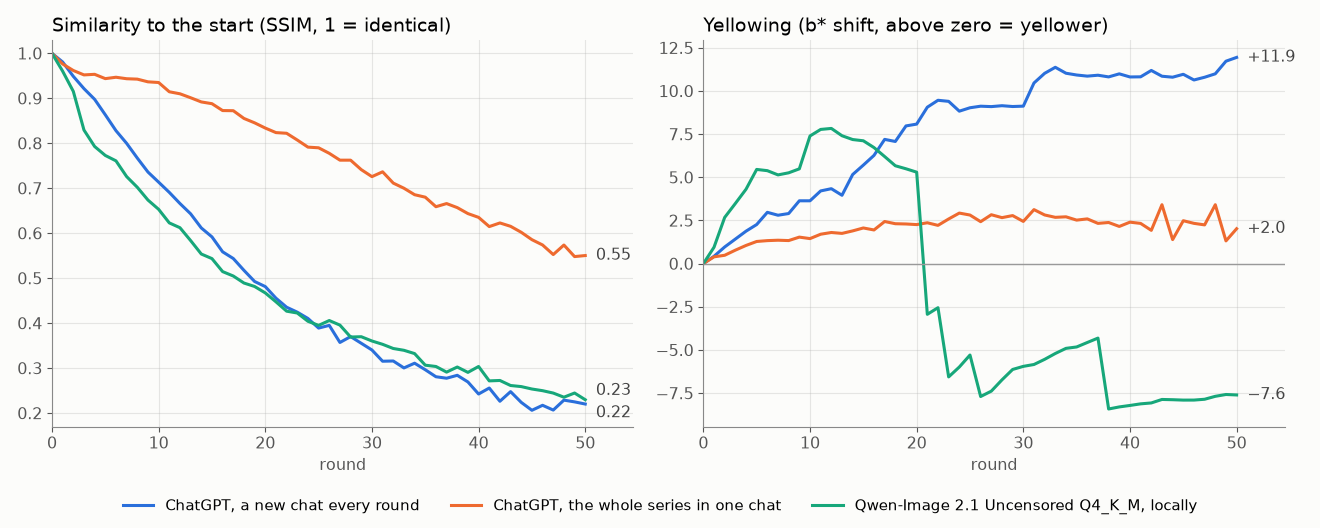
But SSIM doesn't respond only to shapes. A change in brightness and contrast lowers it too, so for a copy that only gets lighter and sharper it drops even while the composition holds. So I matched the brightness and contrast of each copy to the start and computed SSIM again. After fifty rounds the one chat stayed clearly on top (0.61), while the new chat and Qwen ended almost equally low (0.28 and 0.27).
Alignment isn't cosmetic, either. Without it, the graph for Qwen showed a collapse in round fifteen: SSIM fell from 0.45 to below 0.05. In reality the image had only zoomed out to 0.957 of its original size and the pixels stopped lining up. After alignment the curve is smooth. A sharp drop in a single round can be nothing more than a shifted frame, not the image falling apart.
The result after fifty rounds
Similarity to the start after round 50 (SSIM):
| series | whole image | face |
|---|---|---|
| new chat | 0.22 | 0.33 |
| one chat | 0.55 | 0.61 |
| Qwen | 0.23 | 0.29 |
Color after round 50:
| series | ΔE | b* shift |
|---|---|---|
| new chat | 49 | +11.9 |
| one chat | 27 | +2.0 |
| Qwen | 35 | −7.6 |
Sharpness relative to the start rose 3.1 times in the new chat, 1.6 times in the one chat and 10.6 times for Qwen.
The one chat moved away from the start the slowest. It fell below 0.7 only in round 34, the new chat already in round 11 and Qwen in round 9. At the end it holds 0.55. The new chat was down to that by round 17. The new chat and Qwen ended at 0.22 and 0.23, roughly where the blurred start sits. This isn't a swing in a single round: from round two on, the one chat is higher than the new chat in every round, and from round five on by at least 0.08.
I have to say right away how strong this is. Each series is a single run from one starting image with one sentence. I don't know how much a second run of the same series would differ from the first, so I can't say what size of difference is still within chance. The difference is large and consistent, but it is still one observation per series, not a conclusion about the model. On top of that, the two ChatGPT series didn't run at the same time, so I can't rule out a change on the service's side between them either. I showed in the article One scene, nine runs that a single run isn't enough even for text.
Why the one chat holds, I don't know. One explanation that suggests itself is that in one chat the model has the original uploaded image in its context the whole time and can go back to it, while in a new chat it sees only the latest copy. That isn't verified, and it doesn't quite fit. If the model drew from the original every time, the curve would level off. Instead it keeps falling, by about 0.01 per round from beginning to end, and every copy is more similar to the previous one than to the start. So the drift adds up even in one chat. The new chat lost similarity about three times faster in the first twenty-five rounds, then slowed down as it approached the floor.
What the fiftieth copy looks like
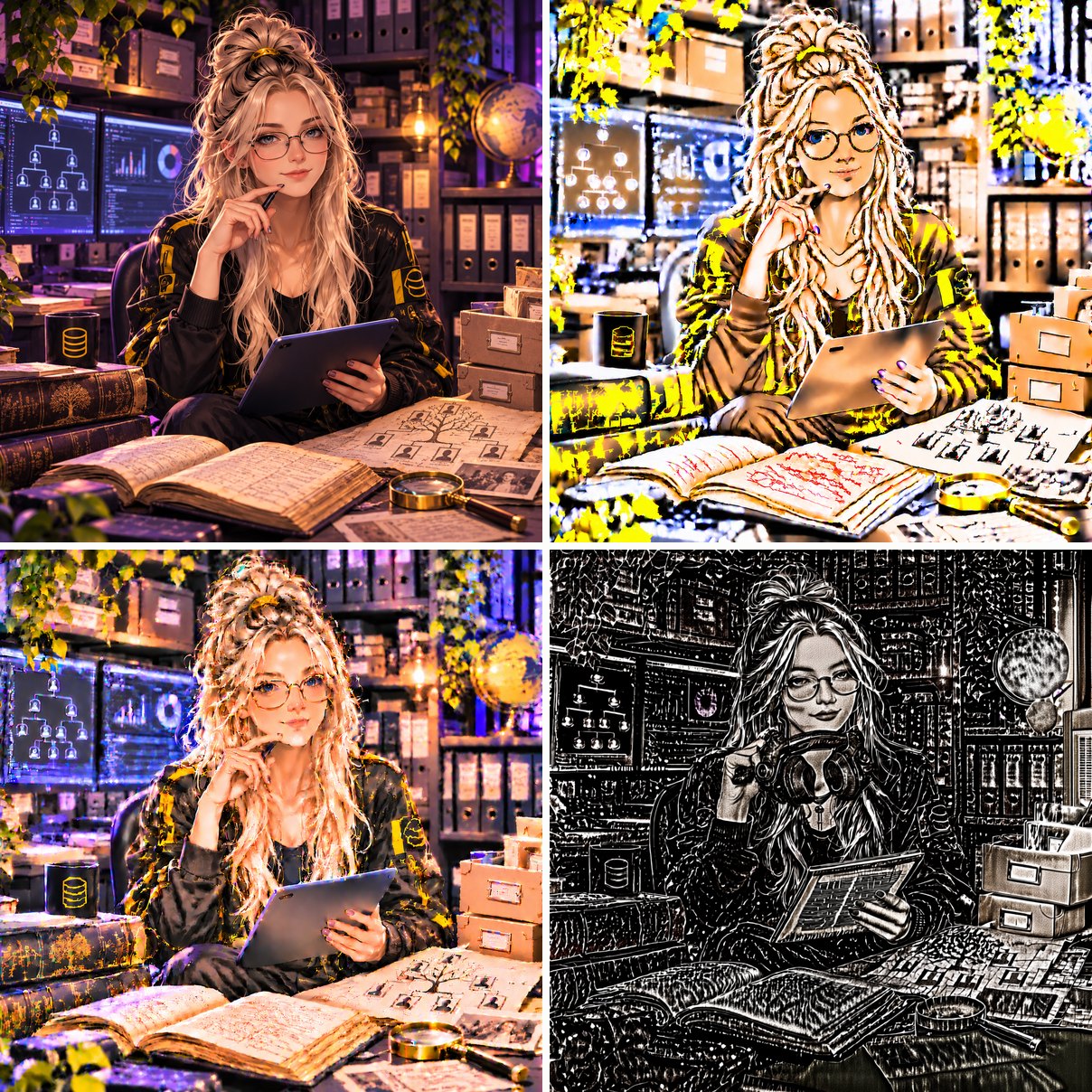
In the new chat series, the composition, the pose and the placement of objects hold. But the image steadily yellows, contrast and saturation rise, areas merge and edges get oversharpened. Around round thirty it looks like a blown-out poster.

In the one chat it is, to the eye, still the same picture. It is warmer and sharper and the hair curls more, but the scene, the background colors and the face have stayed.
By SSIM, Qwen loses similarity as fast as the new chats, just in a different direction. For the first twenty rounds the image turns brown and yellow, and b* climbs as high as +7.8. From round 21 it loses color, turns into a black and white engraving, and b* drops below zero. Sharpness rises tenfold. And it changes objects: the pen in her hand turns into a can and then into headphones. The comparison with ChatGPT isn't entirely fair here. Qwen ran at a different resolution and with a different seed every round, so it shows more where a different kind of model heads than who copies better.

On this portrait and on this night, the copy in one chat moved away from the original the slowest.
Model outputs are shortened and simplified.